Jquery Session Expired Please Try Again Json Code 407
Session handling in any web application is very important and is a must-have feature, without it, we won't exist able to track users and it'south activeness.
In this commodity, I am going to teach you how to handle Session in Node.js. We will utilise express as a framework and various other modules such equally torso-parser to handle grade information.
At the fourth dimension of writing the article, the latest version of Express is four.16.4.
What we are buiding
To demonstrate Session treatment in Node, I have adult a basic Log-in and log-out Organization. In this User tin can log in past providing their email, and that email will be used for further Session tracking. Once the User log-out, Session volition be destroyed and the User volition be redirected to the dwelling page.
Creating Node Project
Allow's create a new Node project. Create a new folder and switch to it using the terminal.
Run this command to create a new Node project.
This command volition create a new package.json file. Let's install the required dependency.
npm install --save express limited-session body-parser
Once the dependencies are installed, nosotros tin can go on to code our app.
How to use Express Session ?
Earlier heading to actual code, i want to put few words about express-sessionmodule. to utilise this module, yous must take to include expressin your project. Like for all packages, we accept to get-go include it.
server.js
const express = require( 'express' ) ;
const session = crave( 'express-session' ) ;
const app = express( ) ;
Afterward this, we have to initialize the session and we tin can practise this by using the post-obit.
app.use(session({secret: 'ssshhhhh'}));
Here 'surreptitious' is used for cookie handling etc just we take to put some cloak-and-dagger for managing Session in Express.
Now using 'asking' variable you can assign session to any variable. Only similar we exercise in PHP using $_SESSIONvariable. for eastward.g
var sess;
app.get ( '/' , function (req,res) {
sess=req.session ;
/*
* Here we take assigned the 'session' to 'sess'.
* Now we can create any number of session variables we want.
* in PHP we do as $_SESSION['var proper name'].
* Here we do like this.
*/
sess.email ; // equivalent to $_SESSION['email'] in PHP.
sess.username ; // equivalent to $_SESSION['username'] in PHP.
} ) ;
Later creating Session variables like sess.email, we can bank check whether this variable is set or not in other routers and tin can runway the Session easily.
Tracking session in global variable won't work with multiple users. This is just for the demonstration.
Project Construction
We are going to put all of Server side lawmaking in the server.js file. Front-end code will be placed within the views folder.
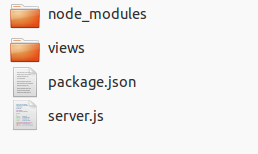
Here is our Server-side code.
server.js
const limited = require( 'express' ) ;
const session = crave( 'express-session' ) ;
const bodyParser = require( 'trunk-parser' ) ;
const router = express.Router ( ) ;
const app = express( ) ;
app.use (session( {secret: 'ssshhhhh' ,saveUninitialized: true ,resave: true } ) ) ;
app.use (bodyParser.json ( ) ) ;
app.apply (bodyParser.urlencoded ( {extended: truthful } ) ) ;
app.use (express.static (__dirname + '/views' ) ) ;
var sess; // global session, NOT recommended
router.become ( '/' , (req,res) => {
sess = req.session ;
if (sess.email ) {
return res.redirect ( '/admin' ) ;
}
res.sendFile ( 'alphabetize.html' ) ;
} ) ;
router.post ( '/login' , (req,res) => {
sess = req.session ;
sess.email = req.body.email ;
res.end ( 'done' ) ;
} ) ;
router.get ( '/admin' , (req,res) => { router.get ( '/logout' , (req,res) => { } ) ; app.use ( '/' , router) ; app.mind (process.env.PORT || 3000 , ( ) => {
sess = req.session ;
if (sess.email ) {
res.write (`<h1>Hi ${sess.email } h1><br>`) ;
res.end ( '+ '>Logout' ) ;
}
else {
res.write ( 'Please login starting time.
' ) ;
res.cease ( '+ '>Login' ) ;
}
} ) ;
req.session.destroy ( (err) => {
if (err) {
return console.log (err) ;
}
res.redirect ( '/' ) ;
} ) ;
console.log (`App Started on PORT ${procedure.env.PORT || 3000 }`) ;
} ) ;
In the code shown above, at that place are four routers. First, which return the home folio, the second router is used for login operation. Nosotros are not doing any authentication here for the sake of simplicity.
The third router is used for the adminarea where the user can only go if he/she is log-in. The fourth and the last router is for session destruction.
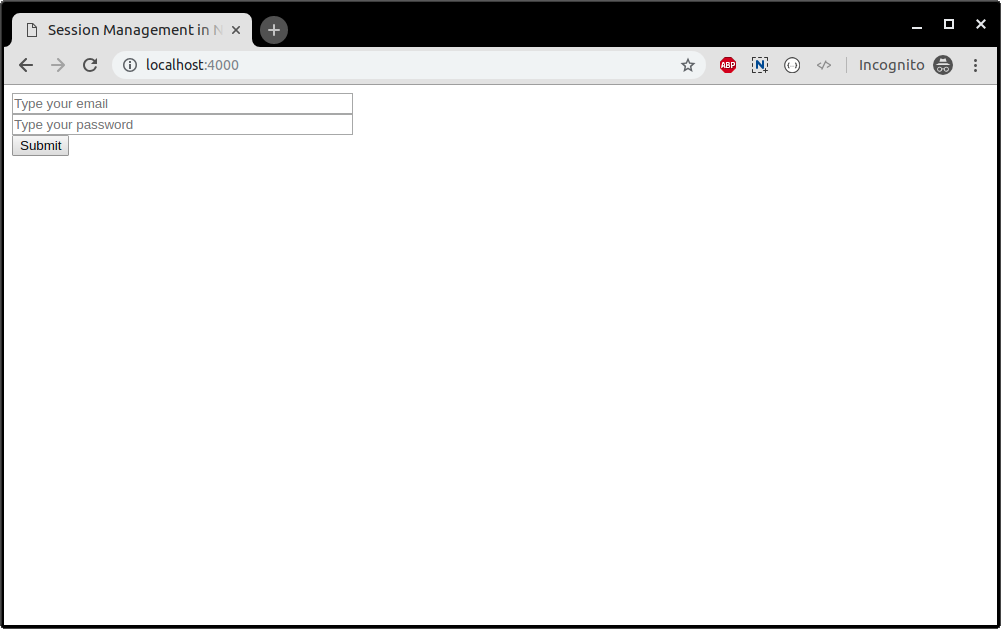
Each router checks whether the sess.emailvariable is fix or not and that could be ready only by logging in through front end-cease. Here is my HTML code which resides in views directory.
views/index.html
<html>
<head>
<title>Session Management in NodeJS using Node and Express</ title>
<script src = "//ajax.googleapis.com/ajax/libs/jquery/2.1.i/jquery.min.js"></ script>
<script>
$(document).ready(function(){
var e-mail,pass;
$("#submit").click(office(){
e-mail=$("#electronic mail").val();
pass=$("#password").val();
/*
* Perform some validation here.
*/
$.post("/login",{email:electronic mail,pass:pass},function(information){
if(data==='washed') {
window.location.href="/admin";
}
});
});
});
</ script>
</ head>
<body>
<input type = "text" size = "40" placeholder= "Blazon your electronic mail" id = "email"><br />
<input type = "countersign" size = "40" placeholder= "Type your password" id = "countersign"><br />
<input type = "push" value = "Submit" id = "submit">
</ trunk>
</ html>
In jQuery lawmaking, we are calling our Router '/login' and redirecting it to the 'admin' if log-in is successful, you lot tin add together validation to fields as per your requirement, for demo purpose i have not added any.
The Bug Warning!
As I accept mentioned earlier, using a global variable for the session won't work for multiple users. You lot volition receive the same session information for all of the users.
And so how do we solve this? Past using a session store.
We relieve every session in the shop so that 1 session will belong to one user only. I accept explained and build session shop using Redis in this commodity.
For a quick reference, he is how we can extend the code shown higher up using Redis as a session store.
Beginning, you need to install Redis on your computer. Click here to larn how to install Redis.
Then, install these dependencies in your project.
npm i --Southward redis connect-redis
Here is the codebase later on upgrading information technology to support Redis.
server.js
/*
* Manage Session in Node.js and ExpressJS
* Writer: Shahid Shaikh
* Version : 0.0.ii
*/
const limited = require( 'express' ) ;
const session = require( 'express-session' ) ;
const bodyParser = require( 'body-parser' ) ;
const redis = require( 'redis' ) ;
const redisStore = require( 'connect-redis' ) (session) ;
const client= redis.createClient ( ) ;
const router = express.Router ( ) ;
const app = express( ) ;
app.utilise (session( {
secret: 'ssshhhhh' ,
// create new redis store.
shop: new redisStore( { host: 'localhost' , port: 6379 , customer: client,ttl : 260 } ) ,
saveUninitialized: false ,
resave: false
} ) ) ;
app.use (bodyParser.json ( ) ) ;
app.use (bodyParser.urlencoded ( {extended: true } ) ) ;
app.use (express.static (__dirname + '/views' ) ) ;
router.become ( '/' , (req,res) => {
permit sess = req.session ;
if (sess.electronic mail ) {
return res.redirect ( '/admin' ) ;
}
res.sendFile ( 'alphabetize.html' ) ;
} ) ;
router.mail ( '/login' , (req,res) => {
req.session.email = req.body.email ;
res.end ( 'done' ) ;
} ) ;
router.get ( '/admin' , (req,res) => { router.get ( '/logout' , (req,res) => { } ) ; app.apply ( '/' , router) ; app.listen (process.env.PORT || 3000 , ( ) => {
if (req.session.email ) {
res.write (`<h1>How-do-you-do ${req.session.email } h1><br>`) ;
res.end ( '+ '>Logout' ) ;
}
else {
res.write ( 'Please login first.
' ) ;
res.end ( '+ '>Login' ) ;
}
} ) ;
req.session.destroy ( (err) => {
if (err) {
render panel.log (err) ;
}
res.redirect ( '/' ) ;
} ) ;
console.log (`App Started on PORT ${process.env.PORT || 3000 }`) ;
} ) ;
If yous notice in the code shown above, nosotros have removed the global variable. We are using Redis to store our session instead. Try these multiple users and you should meet a unique sessions for each user.
I highly recommend following this commodity for more than detailed information.
How to run example code
Download code and extract the zip file. Open your command prompt or Last and switch to the directory. Install dependency starting time past using.
And so run code using
Visit localhost:3000 to view the app.
Conclusion:
Like I mentioned session is very important for any web application. Node.js allows usa to create an HTTP server and HTTP is a stateless protocol. It stores no information about previous visit and Express solves this problem very beautifully.
Further reading
Nodejs tutorials
Node.js MySQL Tutorial
Programming a Vocalization Controlled Drone Using Node and ARDrone
lombardcuposidere.blogspot.com
Source: https://codeforgeek.com/manage-session-using-node-js-express-4/
0 Response to "Jquery Session Expired Please Try Again Json Code 407"
Post a Comment