The Torus T Can Be Represented Parametrically by the Function
A parametric surface is a surface in the Euclidean infinite which is defined by a parametric equation with two parameters . Parametric representation is a very general way to specify a surface, also as implicit representation. Surfaces that occur in two of the main theorems of vector calculus, Stokes' theorem and the deviation theorem, are frequently given in a parametric grade. The curvature and arc length of curves on the surface, surface area, differential geometric invariants such as the first and second primal forms, Gaussian, mean, and chief curvatures can all be computed from a given parametrization.


Examples [edit]

Torus, created with equations: x = r sin v ; y = (R + r cos 5) sin u ; z = (R + r cos v) cos u .

Parametric surface forming a trefoil knot, equation details in the fastened source lawmaking.
- The simplest type of parametric surfaces is given past the graphs of functions of 2 variables:
- A rational surface is a surface that admits parameterizations by a rational function. A rational surface is an algebraic surface. Given an algebraic surface, it is ordinarily easier to make up one's mind if it is rational than to compute its rational parameterization, if it exists.
- Surfaces of revolution requite another important class of surfaces that tin be hands parametrized. If the graph z = f(x), a ≤ x ≤ b is rotated about the z-axis then the resulting surface has a parametrization Information technology may as well be parameterizedshowing that, if the office f is rational, and then the surface is rational.
- The straight round cylinder of radius R about x-centrality has the post-obit parametric representation:
- Using the spherical coordinates, the unit sphere can be parameterized by This parametrization breaks downwardly at the north and south poles where the azimuth angle θ is not adamant uniquely. The sphere is a rational surface.





The same surface admits many different parametrizations. For case, the coordinate z-plane can be parametrized as

for whatsoever constants a, b, c, d such that advert − bc ≠ 0, i.eastward. the matrix is invertible.

Local differential geometry [edit]
The local shape of a parametric surface tin can be analyzed by because the Taylor expansion of the function that parametrizes it. The arc length of a bend on the surface and the surface expanse can be constitute using integration.
Notation [edit]
Let the parametric surface be given past the equation

where is a vector-valued function of the parameters (u, v) and the parameters vary inside a sure domain D in the parametric uv-plane. The first fractional derivatives with respect to the parameters are usually denoted and and similarly for the higher derivatives,


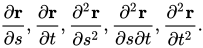
In vector calculus, the parameters are ofttimes denoted (s,t) and the fractional derivatives are written out using the ∂-notation:
Tangent airplane and normal vector [edit]
The parametrization is regular for the given values of the parameters if the vectors

are linearly contained. The tangent aeroplane at a regular point is the affine plane in R 3 spanned by these vectors and passing through the signal r(u, v) on the surface determined by the parameters. Any tangent vector tin be uniquely decomposed into a linear combination of and The cross product of these vectors is a normal vector to the tangent aeroplane. Dividing this vector by its length yields a unit normal vector to the parametrized surface at a regular point:


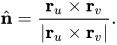
In general, at that place are ii choices of the unit normal vector to a surface at a given signal, but for a regular parametrized surface, the preceding formula consistently picks one of them, and thus determines an orientation of the surface. Some of the differential-geometric invariants of a surface in R three are defined by the surface itself and are independent of the orientation, while others change the sign if the orientation is reversed.
Expanse [edit]
The expanse can exist calculated by integrating the length of the normal vector to the surface over the appropriate region D in the parametric uv plane:

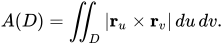
Although this formula provides a closed expression for the surface area, for all but very special surfaces this results in a complicated double integral, which is typically evaluated using a computer algebra organisation or approximated numerically. Fortunately, many common surfaces form exceptions, and their areas are explicitly known. This is truthful for a round cylinder, sphere, cone, torus, and a few other surfaces of revolution.
This can also exist expressed every bit a surface integral over the scalar field 1:

Commencement central grade [edit]
The first primal class is a quadratic form

on the tangent airplane to the surface which is used to calculate distances and angles. For a parametrized surface its coefficients can be computed equally follows:

Arc length of parametrized curves on the surface S, the angle between curves on S, and the surface surface area all admit expressions in terms of the beginning fundamental form.
If (u(t), five(t)), a ≤ t ≤ b represents a parametrized curve on this surface then its arc length tin can exist calculated as the integral:

The start key class may be viewed as a family of positive definite symmetric bilinear forms on the tangent plane at each signal of the surface depending smoothly on the indicate. This perspective helps one calculate the bending betwixt two curves on S intersecting at a given point. This angle is equal to the bending between the tangent vectors to the curves. The commencement fundamental form evaluated on this pair of vectors is their dot product, and the bending tin be found from the standard formula
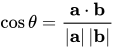
expressing the cosine of the angle via the dot production.
Area can exist expressed in terms of the get-go fundamental form as follows:

By Lagrange's identity, the expression under the square root is precisely , and then it is strictly positive at the regular points.

Second fundamental form [edit]
The second fundamental grade

is a quadratic form on the tangent plane to the surface that, together with the first fundamental grade, determines the curvatures of curves on the surface. In the special instance when (u, 5) = (10, y) and the tangent airplane to the surface at the given point is horizontal, the 2nd cardinal course is essentially the quadratic part of the Taylor expansion of z as a function of x and y.
For a general parametric surface, the definition is more than complicated, but the 2d cardinal course depends only on the partial derivatives of society one and two. Its coefficients are defined to exist the projections of the second partial derivatives of onto the unit normal vector divers by the parametrization:


Like the first central form, the second fundamental form may be viewed as a family of symmetric bilinear forms on the tangent airplane at each bespeak of the surface depending smoothly on the point.
Curvature [edit]
The first and second key forms of a surface make up one's mind its of import differential-geometric invariants: the Gaussian curvature, the mean curvature, and the main curvatures.
The principal curvatures are the invariants of the pair consisting of the second and first fundamental forms. They are the roots κ one, κ 2 of the quadratic equation

The Gaussian curvature Chiliad = κ 1 κ two and the mean curvature H = (κ 1 + κ two)/2 can exist computed as follows:

Up to a sign, these quantities are independent of the parametrization used, and hence course important tools for analysing the geometry of the surface. More than precisely, the primary curvatures and the mean curvature modify the sign if the orientation of the surface is reversed, and the Gaussian curvature is entirely contained of the parametrization.
The sign of the Gaussian curvature at a point determines the shape of the surface near that indicate: for M > 0 the surface is locally convex and the bespeak is called elliptic, while for K < 0 the surface is saddle shaped and the point is chosen hyperbolic. The points at which the Gaussian curvature is cypher are called parabolic. In general, parabolic points form a bend on the surface chosen the parabolic line. The start fundamental course is positive definite, hence its determinant EG − F 2 is positive everywhere. Therefore, the sign of K coincides with the sign of LN − Yard 2 , the determinant of the second cardinal.
The coefficients of the first fundamental form presented above may be organized in a symmetric matrix:
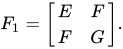
And the same for the coefficients of the 2d fundamental class, also presented to a higher place:
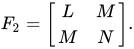
Defining now matrix , the principal curvatures κ ane and κ 2 are the eigenvalues of A.[i]

Now, if five 1 = (v 11, five 12) is the eigenvector of A corresponding to principal curvature κ i, the unit vector in the direction of is called the principal vector corresponding to the principal curvature κ i.

Accordingly, if five 2 = (v 21,5 22) is the eigenvector of A corresponding to principal curvature κ ii, the unit vector in the direction of is called the principal vector respective to the principal curvature κ 2.

See also [edit]
- Spline (mathematics)
- Surface normal
References [edit]
- ^ Surface curvatures Handouts, Principal Curvatures
External links [edit]
- Java applets demonstrate the parametrization of a helix surface
- m-ART(3d) - iPad/iPhone application to generate and visualize parametric surfaces.
lombardcuposidere.blogspot.com
Source: https://en.wikipedia.org/wiki/Parametric_surface
0 Response to "The Torus T Can Be Represented Parametrically by the Function"
Post a Comment